

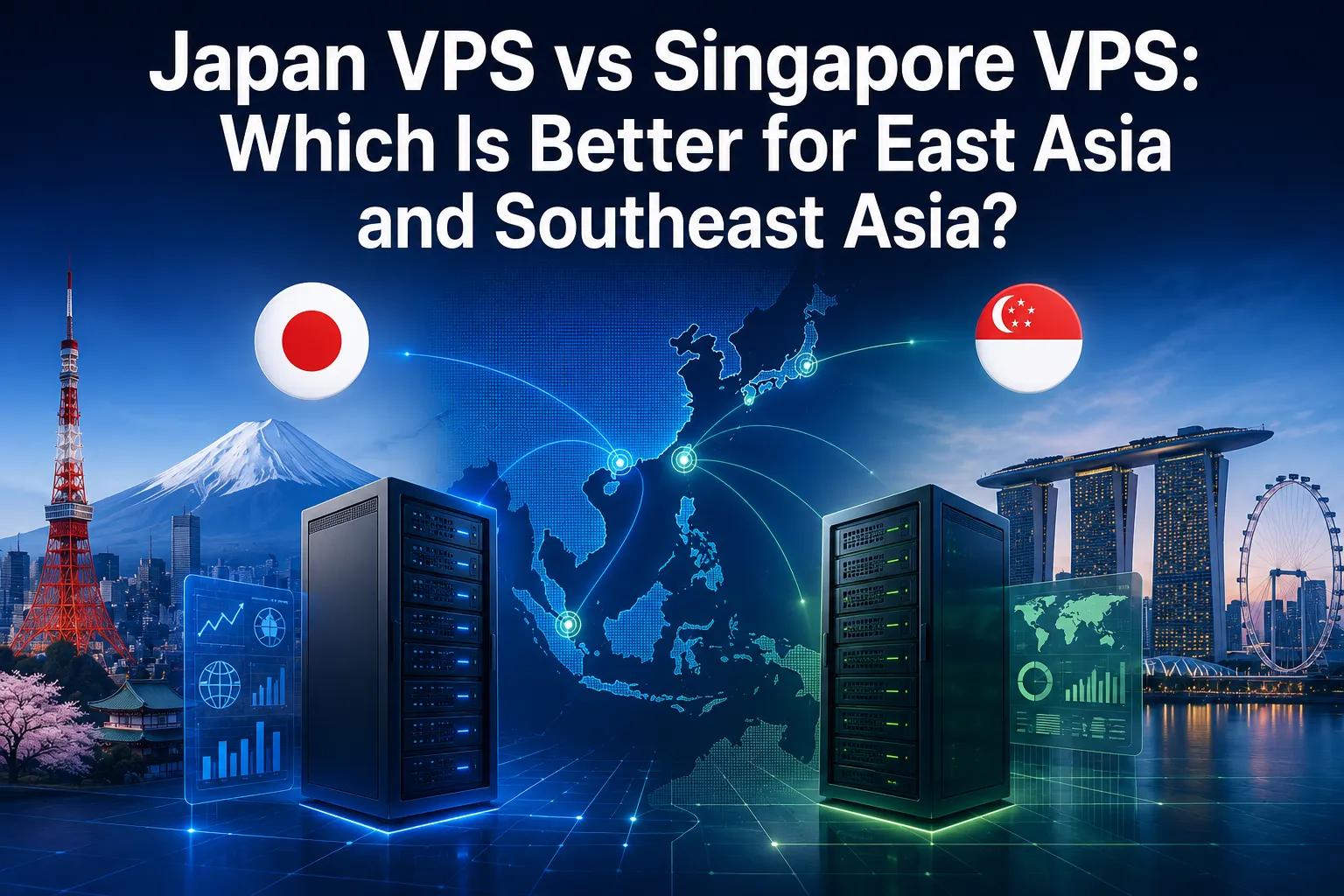
When comparing Japan VPS and Singapore VPS, the right answer depends less on broad geography and more on where your users, workloads, and operations are actually centered. While both locations can support Asia-focused infrastructure, they are not interchangeable in practice. Japan is often the better fit for services aimed at Japan and nearby East Asian markets, while Singapore can be a practical regional base for broader Southeast Asia coverage.
In this article, we look at the real difference between Japan VPS and Singapore VPS from the perspective of latency, regional alignment, workload type, and operational fit. If you are deciding where to place websites, business systems, remote desktop environments, or Windows-based workloads in Asia, this guide will help you choose the location that best matches your actual traffic and business priorities.
Why VPS Location Still Matters in Asia
Even in the age of global cloud services, server location still has a direct impact on user experience. A shorter, more efficient network path can improve page load times, API responsiveness, remote desktop performance, transaction timing, and overall application stability. This matters for customer-facing services, internal tools, development environments, and Windows-based remote operations alike.
That said, latency is not determined solely by the physical distance between a user and a data center. Two cities may appear close on a map yet still deliver very different results because of routing policies, ISP peering, international transit paths, or network congestion. A location that looks ideal in theory may not always provide the lowest practical latency for your audience.
This is especially important in Asia, where traffic is often distributed unevenly across markets. A company may say it serves “Asia,” but in practice, most of its traffic may come from Japan, Korea, Taiwan, Singapore, Malaysia, Thailand, or Indonesia. Once you identify where your most important users are actually located, the decision between Japan VPS and Singapore VPS becomes much easier.
In other words, VPS location still matters because proximity to users still affects real-world performance. Not in isolation, but as part of a broader performance strategy.

Japan VPS vs Singapore VPS: The Core Difference
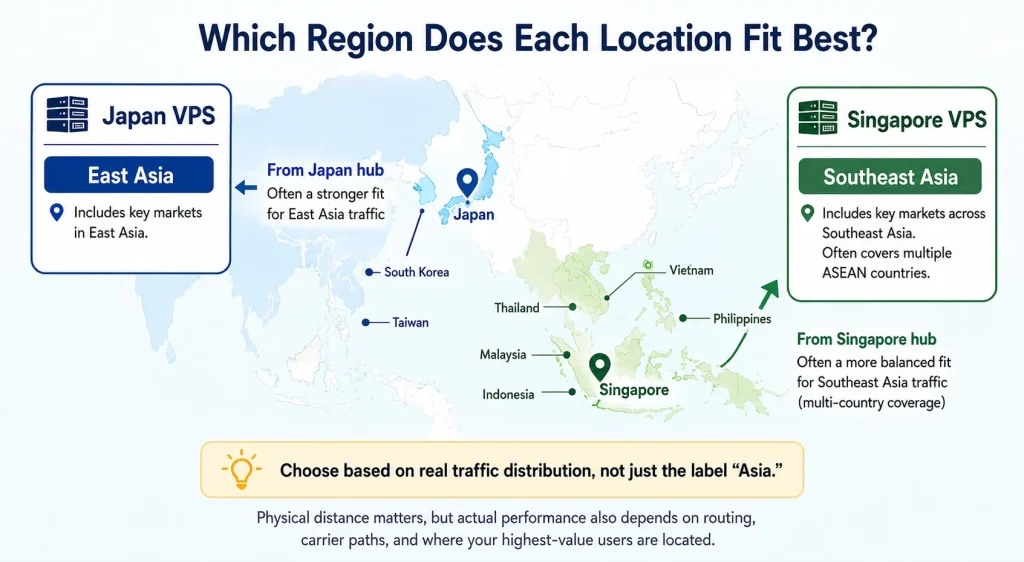
The clearest difference between Japan VPS and Singapore VPS is how each location aligns with your target region. In broad terms, Japan is often the more natural choice for East Asia, while Singapore is often better suited to Southeast Asia. That does not mean one location is universally faster or better than the other. It means each location tends to perform best for a different traffic pattern.
A Japan VPS is often a strong choice when your users are concentrated in Japan, Korea, Taiwan, or other nearby East Asian markets. It can also make sense when your service is aimed at the Japanese market, your partners are based in Japan, or you need a Japan-based Windows environment for remote work, software operations, or regional testing.
By contrast, a Singapore VPS is often a strong option when your user base is concentrated in Southeast Asia. Singapore is widely treated as a regional hub for countries such as Malaysia, Indonesia, Thailand, Vietnam, and the Philippines. If your traffic is distributed across several of those markets, Singapore may offer a more balanced regional position.
So the real question is not “Which location is better?” but “Which location is better for my most important users and workloads?” Once you frame the question that way, the trade-offs become clearer and more useful.
Which Location Performs Better by Region?
East Asia: When Japan VPS Has the Edge
If your primary audience is in Japan, a Japan VPS is usually the most direct fit. Hosting close to your Japanese users can reduce unnecessary international hops and support a more responsive user experience for websites, web apps, remote systems, and business tools. This can be particularly valuable for services that need to feel local and consistent rather than merely being “accessible from Asia.”
Japan can also be a strong option for nearby East Asian markets such as Korea and Taiwan. While exact performance always depends on routing and carrier paths, Japan is often better aligned than Singapore for traffic centered in the northern part of the Asia-Pacific region. If most of your daily usage comes from East Asia, Japan is often the more intuitive place to begin your testing.
This is also true for teams with operational ties to Japan. If your staff, vendors, or customers are in Japan, or if your platform is designed around the Japanese market, hosting in Japan can help align your infrastructure with your actual business footprint. In these cases, choosing Japan is not just about raw latency. It is also about keeping your infrastructure closer to the region that matters most to your operations.
That said, “East Asia” should not be used as a vague label. If your traffic is actually split between Japan and Southeast Asia, or if your key application users are outside Japan, then the decision may require a more balanced approach. Japan has the edge when East Asia is truly your center of gravity.
Southeast Asia: When Singapore VPS Makes More Sense
If your audience is concentrated in Southeast Asia, Singapore is often the more logical default. Many businesses treat Singapore as a regional infrastructure hub because it sits close to several major ASEAN markets and is commonly used for regional hosting strategies. If your traffic mainly comes from countries such as Singapore, Malaysia, Indonesia, Thailand, Vietnam, or the Philippines, a Singapore VPS may reduce average distance and provide better balance across that user base.
This is especially relevant when your goal is not to optimize for one single country but to support a broader Southeast Asian footprint. A Singapore-based location can act as a middle ground for businesses serving multiple markets in the region, particularly when no single East Asian country dominates total usage.
Singapore may also make more sense for teams whose own operations are based in Southeast Asia. If your developers, operators, or customer support teams are located there, placing infrastructure closer to them may improve administrative responsiveness and day-to-day operational comfort.
However, Singapore is not automatically the right answer just because you say you serve “Asia.” If your high-value traffic comes mainly from Japan or nearby East Asian markets, Japan may still deliver a better experience for the users who matter most. The better location is the one that aligns with your actual audience distribution, not a broad regional label.
How Workload Type Changes the Best Choice
Region matters, but workload type matters as well. Two companies serving the same countries may still choose different VPS locations depending on what their systems actually do.
For customer-facing websites and web applications, end-user location is usually the strongest factor. If users are mostly in Japan and East Asia, Japan is often the better performance base. If users are mainly in Southeast Asia, Singapore may provide a more balanced experience. In these cases, the key question is simple: where are the users who will experience the delay most directly?
For internal tools, remote desktop environments, and Windows-based operational systems, the decision can depend on both user location and operator location. If your staff connects daily to a Windows environment for administration, software use, or workflow execution, the responsiveness of the session matters. That includes cursor responsiveness, input delay, screen refresh smoothness, and connection stability. A location closer to the people actually using the environment can make daily operations more comfortable and productive.
This is one reason a Japan Windows VPS can be appealing for companies working closely with the Japanese market. If the environment is used by staff in Japan or by teams that need a Japan-based operational footprint, Japan becomes a strong choice not only for end-user performance but also for operational relevance and workflow alignment.
Development and testing environments add another layer. Sometimes the most important factor is not the users themselves, but the APIs, databases, SaaS platforms, third-party services, or enterprise systems your environment needs to communicate with. If those connected systems are primarily in Japan, a Japan VPS may still be the better fit even if some users are elsewhere. If your integrations are regionally centered in Southeast Asia, Singapore may be more practical.
In short, you should not choose based on geography alone. You should choose based on who uses the system, where they are, and what the system needs to communicate with.
When a Japan VPS Is the Better Fit
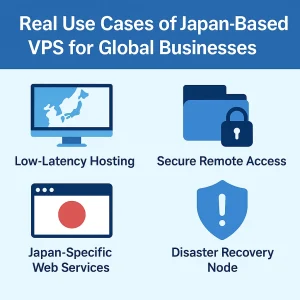
Because this article is a comparison, it is important to remain balanced: Singapore is a valid choice for many workloads. However, there are also clear situations where a Japan VPS is the better fit from a strategic perspective, not just a technical one.
First, Japan is often the stronger choice when your service is clearly East Asia-first. If Japan is your main market, or if you expect most usage from Japan and nearby East Asian countries, hosting in Japan gives your infrastructure a foundation that is more closely aligned with that region. That can support better responsiveness where it matters most and avoid optimizing too heavily for users who are not your primary audience.
Second, a Japan VPS is often a better fit when you need a Japan-based operating environment rather than just general-purpose hosting in Asia. This is especially relevant for Windows workloads, remote desktop operations, line-of-business tools, managed administrative tasks, and regional testing environments. If your team needs a stable Japan-based Windows environment, choosing Japan is often the more natural option than using a Southeast Asia hub that is geographically broader but less aligned with your actual use case.
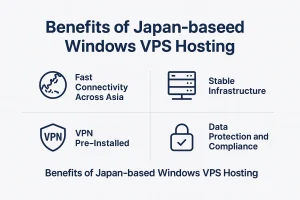
Third, Japan may be the better choice when your infrastructure needs to match your market positioning. If you are building services for Japanese users, supporting Japanese clients, or maintaining business systems tied to Japan, then location can contribute to operational consistency. Infrastructure choices also signal where your service is anchored and which market it is built to support.
That does not mean Japan should be selected blindly. If most of your users are in Southeast Asia, Singapore may still be the more efficient option from a latency standpoint. But if your real priority is East Asia, Japan-facing services, or Japan-based operations, then a Japan VPS is often the stronger overall choice.
How to Make the Right Choice
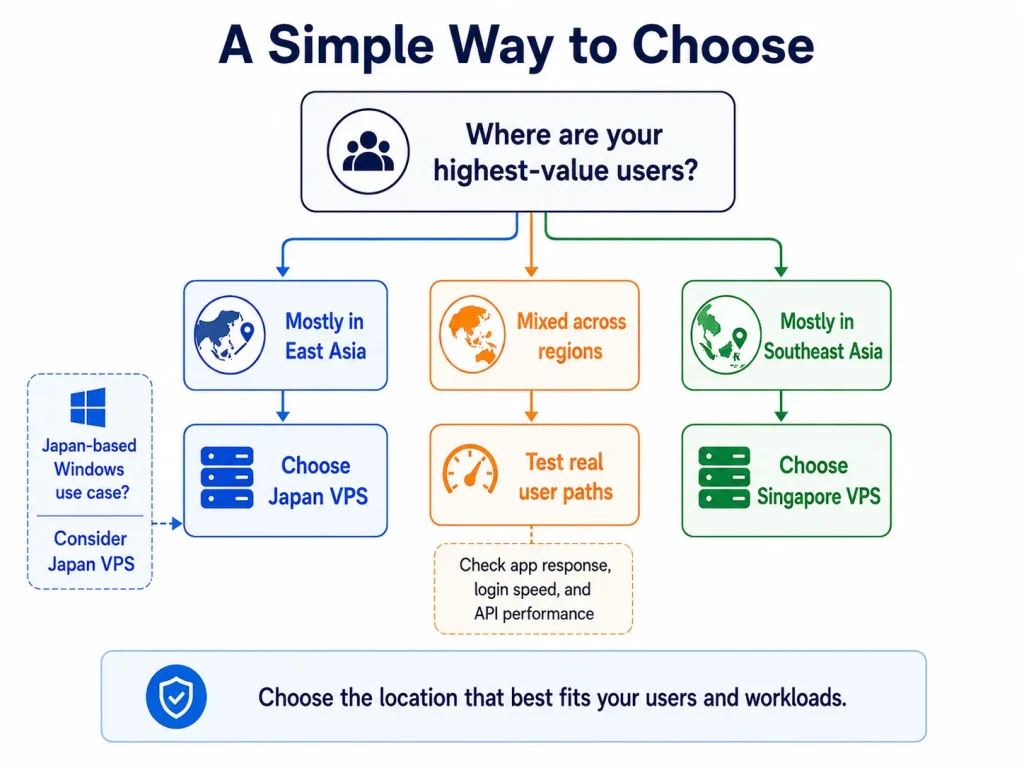
Choose Japan If …
Choose Japan if your most important users are in Japan or nearby East Asian markets such as Korea and Taiwan. Japan also makes sense if your application, business workflows, or remote environment are closely tied to the Japanese market. If your teams need a Japan-based Windows environment, or if your infrastructure strategy is built around serving Japan first, a Japan VPS is often the most direct and strategically aligned option.
Japan is also a strong choice when “Asia” is not your actual market, but rather a broad label that actually masks a more specific East Asia focus. In that situation, optimizing for Japan and nearby users is usually more valuable than trying to balance across the entire region.
Choose Singapore If …
Choose Singapore if your users are primarily in Southeast Asia or spread across several ASEAN markets. If no single East Asian country dominates your traffic, and you want a practical regional base for countries such as Singapore, Malaysia, Indonesia, Thailand, Vietnam, and the Philippines, Singapore may provide a more balanced regional result.
Singapore may also be the better fit when your operational team is based in Southeast Asia or when your integrations and partner systems are concentrated there. In these cases, hosting closer to the center of your actual operational activity often matters more than choosing a location based on brand familiarity or broad assumptions about Asia.
Test with Your Real User Paths Before You Commit
No comparison article can replace real-world testing. Even strong location logic should be validated with your actual user paths, application behavior, and connected systems. What looks best on paper may perform differently once routing, ISP behavior, and workload-specific patterns enter the picture.
Before you commit to a location, test from the regions that matter most to you. Measure not only ping time, but also application response, login time, remote session responsiveness, file transfer behavior, and API responsiveness where relevant. If you have mixed traffic across East Asia and Southeast Asia, decide which users matter most to business outcomes, then optimize for that priority instead of chasing a perfect average that may not exist.
The right answer is often not “Japan is faster” or “Singapore is better.” The right answer is “this location is better for our users, our workload, and our operating model.”

Conclusion
Japan VPS and Singapore VPS are both valid choices for Asia-focused infrastructure, but they support different priorities. If your center of gravity is in East Asia, Japan is often the stronger fit. If your user base is concentrated in Southeast Asia, Singapore may be more practical. If your traffic is mixed, the best decision depends on where your highest-value users are located and how your systems are actually used.
For many businesses, the answer becomes clearer once they stop asking which location is “best for Asia” and start asking which location is best for their primary market. If that market is Japan or East Asia, a Japan VPS is often the more effective place to start testing and deployment.
FAQ
Q1. Is Japan VPS always faster than Singapore VPS?
No. Japan VPS is not always faster than Singapore VPS. The better location depends on where your users are, how traffic is distributed, and how your network routes actually behave in practice.
Q2. When should I choose a Japan VPS instead of a Singapore VPS?
You should usually choose a Japan VPS when your primary users, business operations, or connected systems are centered in Japan or nearby East Asian markets such as Korea and Taiwan.
Q3. Is Singapore VPS better for serving Southeast Asia?
In many cases, yes. If your traffic is spread across several Southeast Asian countries, Singapore can be a practical regional base that provides more balanced performance across those markets.
Compare Japan VPS Plans for Your Asia Strategy
If your users, workloads, or business operations are centered in Japan or East Asia, the next step is to compare Japan VPS plans based on performance, operational fit, and your actual regional priorities.